Mentoring and time management turned out to be more connected than I expected. Every other Monday, I sit down with a guy named Andrew. We were paired through a mentoring program run by PMI Northeast Indiana, which deserves real credit here. They take people who’ve already earned their PMP certification (Project Management Professional) and pair them with people who are working toward theirs, creating a structure for that knowledge to actually transfer instead of staying locked up in individual careers. It’s a smart, simple idea, and more organizations should be doing something like it.
How I Got Paired With Andrew (PMI Northeast Indiana Mentoring Program)
I’ve held my PMP for over 10 years now. Andrew is earlier in that certification journey, working toward his. He’s not new to business by any stretch, he brings real experience to the table. But the PMP process itself is newer ground for him, and that’s the piece I’m there to help with.
Why I Mentor
Mentoring has become one of my favorite things about being further along in my career. It’s not something I do because it looks good on a profile. It’s how I pay forward what other people gave me when I had nothing to offer in return.
I think about a handful of people who invested in me along the way. Not teachers, not professors, I mean the co-workers who cared and the bosses who saw something in me before I saw it in myself. Rod Brooks, who helped me find my footing in broadcasting. Jan Wagner, who taught me sales, marketing, and what relationship selling actually means. Lori Grass, who taught me how to be organized and how to actually lead a team, not just manage one. Henry Bird, who taught me how to analyze a business instead of just react to it. Brad Williams, who taught me why heart and culture aren’t soft stuff, they’re the whole game.
There are more names I could list, and that’s exactly the problem, this is starting to feel like an awards show acceptance speech where you know you’re about to leave someone off no matter how careful you are. So to everyone I didn’t name here: it’s not that I forgot what you gave me. It’s that there wasn’t room to list you all, and I’m still grateful.
That’s the debt I’m trying to pay down with people like Andrew. Every other Monday, sixty minutes, no rigid agenda. Mentoring and time management was a part of their business approach, and I want to pass that along to those I work with.
Mentoring and Time Management: The Day Andrew Became the Mentor
A few weeks ago, one of those sessions flipped on me.
Andrew told me about something he calls “Build Thursday.” Every Thursday, he blocks the entire day. No meetings. No reactive fire drills. Just time set aside to work on the big picture stuff for himself and his company, the projects and ideas that matter most and somehow never get worked on because something louder is always demanding attention first.
I sat there for a second before I said anything. Because I didn’t come up with that. He did.
Here’s the thing about being the person who builds systems for a living. You get good at diagnosing everyone else’s time problems. You can walk into a team that’s drowning in ad hoc status updates and see exactly why nothing moves, and you can build the tracking, the meeting cadence, the accountability structure that fixes it. I’ve done that more times than I can count.
But somewhere in all that fixing, I never built the version of that for myself. My calendar is a graveyard of good intentions, blocks that get eaten alive by whatever’s loudest that day. I’ve told other people for years to protect their strategic time. I hadn’t protected mine.
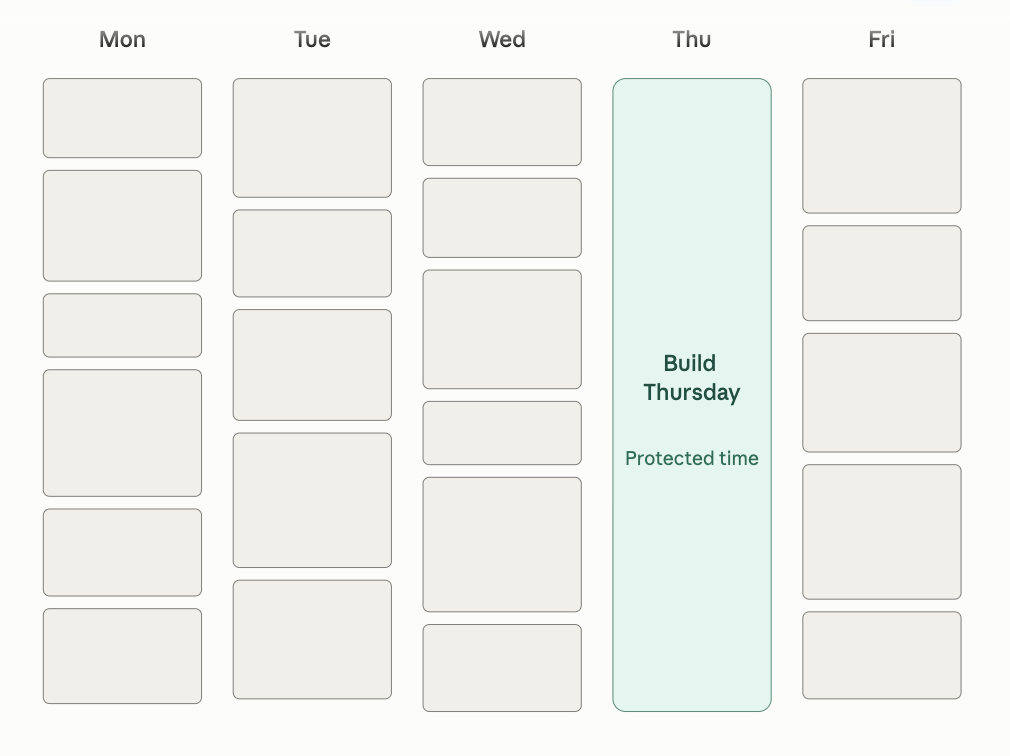
Meetings Aren’t the Work
It’s easy to go from meeting to meeting and call that work. But a good meeting produces work to be done, it isn’t the work itself. Meetings matter, don’t get me wrong. They’re a real and necessary step in the process. But they’re a step toward productivity, not productivity itself. Finding the time to actually do the work a good meeting generates, that’s the part that’s easy to lose. This is really the heart of mentoring and time management as I’ve come to understand it, protecting the hours where the actual thinking happens.
That’s the part about mentoring nobody really prepares you for going in. You show up thinking your job is to hand someone a framework. And if you’re paying attention, every once in a while you walk away holding one yourself.
I don’t think this is an accident, either. The best mentoring relationships I’ve had, on either side of the table, have never been one-directional information transfer. They’ve been two people thinking out loud together, and the seniority in the room just determines who’s asking more of the questions. Andrew didn’t need me to tell him time management was important. He needed space to think it through, and he arrived at something better than what I would have handed him.
What I’m Still Figuring Out
So now I’m wrestling with what my own version of Build Thursday would even look like. What would stay on the calendar. What would have to be protected, and what I’d have to let go of to make room. I don’t have it figured out yet, and I’m not sure I will anytime soon. But I know I need one, and I know exactly where the idea came from.
Mentoring and time management may seem like two separate conversations, but this whole experience taught me they’re really the same one. If you mentor someone, or someone mentors you, I’d bet you’ve had a moment like this too, where the direction of the learning quietly reversed on you. I’d love to hear about it.
Leave a Reply
You must be logged in to post a comment.