Leading with gratitude is my number one job for my team this quarter. Today marks the beginning of Q4, which for many businesses is the make-or-break stretch of the year. The demands of the final revenue push, coupled with the added stress of the holidays and family obligations, can make for a hectic, anxiety-filled three months.
So as we started the quarter this week, I paused our normal team conversation about plans, projects, and results, and focused instead on the need to show patience, grace, and gratitude.
The Trap of Results-Only Leadership
I’m a results-driven individual. The teams I’ve led and the businesses I’ve helped run can all attest to the fact that my eyes rarely divert from activities that drive the bottom line. So me writing this and preaching about the soft skills of patience, grace, and gratitude doesn’t sound very bottom-line focused. But I would argue that it is actually very much a bottom-line play.
Keeping your team feeling good about their work and minimizing stress whenever possible are key components in driving results. But all too often leaders are laser-focused on results, and results only. Those leaders who are bottom-line focused at all costs are quick to burn out their team, experience high turnover, and ultimately not be able to deliver on the very results they were driving to hit.
“Not everything that can be counted counts, and not everything that counts can be counted,” is a famous line from William Bruce Cameron in 1963. And 60+ years later, that line still holds up. My way of embracing the importance of those intangibles is to focus on patience, grace, and gratitude.
Patience: Giving People Room to Grow
Patience isn’t one of my strong suits, but it’s one I’m working to improve, for my own sake and for my team’s. What I keep learning is that the goal I need hit, and the timeline I want it hit on, don’t always match where my teammate actually is in the moment.
Knowing when to press and when to hold back is the skill. Not everyone performs under pressure. For some people, pushing harder just gets me a worse result, faster. Hanging back and giving them room, when I can be patient enough to do it, gets me the better outcome I was after in the first place.
That’s the part that took me a while to see: patience here isn’t the opposite of being results-driven. It’s how you actually get the results.
Grace: Leading People Through Their Worst Days
I need a lot of grace in my life. Daily. And I need to do a better job of offering it, especially when the pressure of work ramps up.
Years ago, back in my newspaper days, someone on my team made a mistake. Here’s the thing: I honestly cannot remember today what it was. But at the time, it felt like a big deal. I was upset, frustrated, and I just wouldn’t let it go. I had the person pinned, proving my point over and over, offering no grace whatsoever. My dear friend Bev turned to me and said three words: “Let him up.”
She was right. By giving him grace, I gave him another chance. The employee learned a valuable lesson and kept a skill he’d have lost if I’d run him off. And I created an ally instead of an adversary, the start of a long-term relationship instead of a fragile one, or worse, no relationship at all. That is the trade grace makes.
People are going to make mistakes. How we handle those moments shows what kind of leader we are. Chewing someone out protects your ego. Turning the mistake into a teaching moment is how everyone actually grows, including you. And the thing I was once ready to damage a relationship over? I can’t even remember it now. Most of the time, that’s exactly how big the mistake really was.
Leading with Gratitude: The Habit That Changes How You Lead
Leading with gratitude is the easiest of these three to practice, and the one most often overlooked. The good news is that leading with gratitude compounds: the more you give it, the more the whole team gives it back.
A long-standing practice of mine is to start meetings with “wins and acknowledgements.” We go around the table and each person shares a personal or professional win the team can celebrate together. It sounds small, but acknowledging each other’s accomplishments is leading with gratitude in action, and it builds an atmosphere that carries into everything else the team does.
Leading with gratitude isn’t limited to your own team, either. Going out of your way to show it to other teams pays off too. We all hit moments when we need a favor: a project needs a deadline extension, or a deliverable has to move up the queue. When you’ve been a genuinely grateful co-worker, people want to help you. That’s not the reason you show gratitude, but it’s one of the ways it comes back around.
And the manners your parents taught you still apply. A simple please and thank you costs nothing and signals respect. It’s the floor of leading with gratitude, not the ceiling, but plenty of leaders skip even that.
Last year during Q4, I started the practice of sending notes of gratitude to random people within the organization. Too many times even in an organization that is very people-focused, managers are not leading with gratitude.
So I set out to change that by sending a couple of emails each week. I didn’t start this campaign for the reactions. I started it as a reaction. I was feeling unappreciated myself, and I didn’t want my team to feel the way I did. They deserved better. I deserved better. So I made the change.
The results surprised me. I made more than one person cry. I put smiles on the faces of people who were feeling the pressure of work, people whose own leaders either didn’t see it or chose not to react. Without exception, I received a glowing note back, thanking me and offering gratitude for one simple gesture.
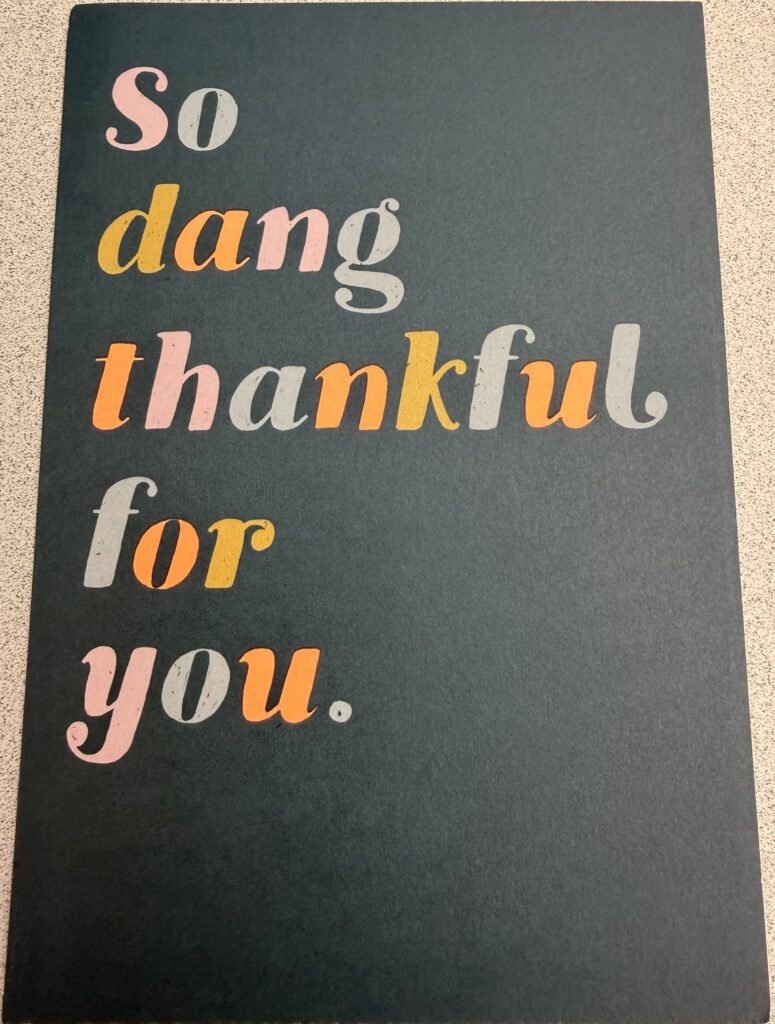
This year, I’ve upped my game. Walking through the grocery store this week, I found a greeting card that read, “So dang thankful for you.” I bought every one they had, and I’ll be looking for more.
Why Stress and Gratitude Pull You in Opposite Directions
Stress and gratitude pull your body in opposite directions. Stress fires up the fight-or-flight response; gratitude quiets it. Researchers have measured it: in one study, people trained to sustain feelings of appreciation showed a 23% drop in the stress hormone cortisol over a single month. You can’t fully feel both at once, which is exactly why leading with gratitude is a tool and not just a nicety. When the pressure climbs, that’s the moment to reach for it.
Right before one of my recent team meetings, after I’d pulled together my notes on patience, grace, and gratitude, someone sent me a video from content creator Ryan Miller. His message was simple: gratitude is a stress reliever, and offering prayers of gratitude reduces anxiety. So as Q4 stressors ramp up, or any other stretch of life for that matter, we have to pause, be intentional, and be grateful.
Starting Small: Practicing This on Monday Morning
I’ve framed this as a Q4 opportunity, but in reality it’s a Monday morning one for you as a leader. The numbers are important. The results matter. But so do the people, and when you focus solely on driving the bottom line, you risk driving away the very people who make those results happen. Pause, take a moment, and start leading with gratitude. Mix in some patience and grace, for your team and for yourself, and build a better team that can deliver long-term results.
Leave a Reply
You must be logged in to post a comment.