Solutions to problems, and good feelings.
If you’ve spent time around me as a salesperson, you’ve no doubt heard me utter that phrase, and I even do training on it. Forget all the various steps to close sales you’ve read about or used — 3 steps, 5 steps, 7 steps. Sales ultimately comes down to two things: solutions to problems and good feelings. Sales and leadership principles both work on those two simple statements.
Everything you purchase comes down to those two simple criteria. Does it solve your problem? Does it provide good feelings? As complicated as sales can be, it all boils down to that.
Think about something you’ve recently purchased. Chances are, one or both of those criteria were fulfilled as part of the sales process. We recently purchased a new vehicle. We are now the proud owners of a Jeep Wrangler.
So why did I make that purchase? We needed a car in our life, one that is reliable in any weather. Did that purchase solve the main problem? Of course it did. And why did we choose a Jeep Wrangler? Because it’s a fun car to drive, and we wanted that experience in our life. That purchase provided good feelings. Any purchase, large or small, can be measured against those two things: does it solve a problem, and does it provide good feelings?
I’ve been doing sales training based on that simple principle for over 20 years, and have come to realize that it is also a great baseline for how to be a better manager.
Applying Sales and Leadership Principles to Your Team
In the late spring of 2005, I was promoted to publisher of my first newspaper. My boss, Henry Bird, walked into my office on one of my first days on the job and said, “Congratulations on the new job. You are now overhead. What are you going to do about it?”
Having spent my entire career up to that point either helping to create content or generating revenue, it was my first time not directly contributing to the product or the revenue of an organization. It was definitely an eye-opener, especially on day one of my time in leadership. But I’m so glad it happened, because it has changed my view ever since.
Viewing myself as overhead changed me and made me a better manager and leader. Continually reminding myself that I needed to do something to help drive results for the bottom line motivated me to be better. I looked for ways to motivate, to improve processes, to negotiate better deals, and so much more — all in response to Henry’s challenge of what I was going to do about it.
Why Sales and Leadership Principles Work Together
But it still came back to those two basic concepts: solutions to problems and good feelings.
Solving problems is a key function of being a manager and leader. The team is looking to you for answers, or at the very least the pathway to find those answers. Looking back on a career that has had me reporting to dozens of managers, the ones who stand out are the ones who not only help you solve problems, but anticipate them before they fully develop. I’ve been fortunate to work under several who do this exceptionally well.
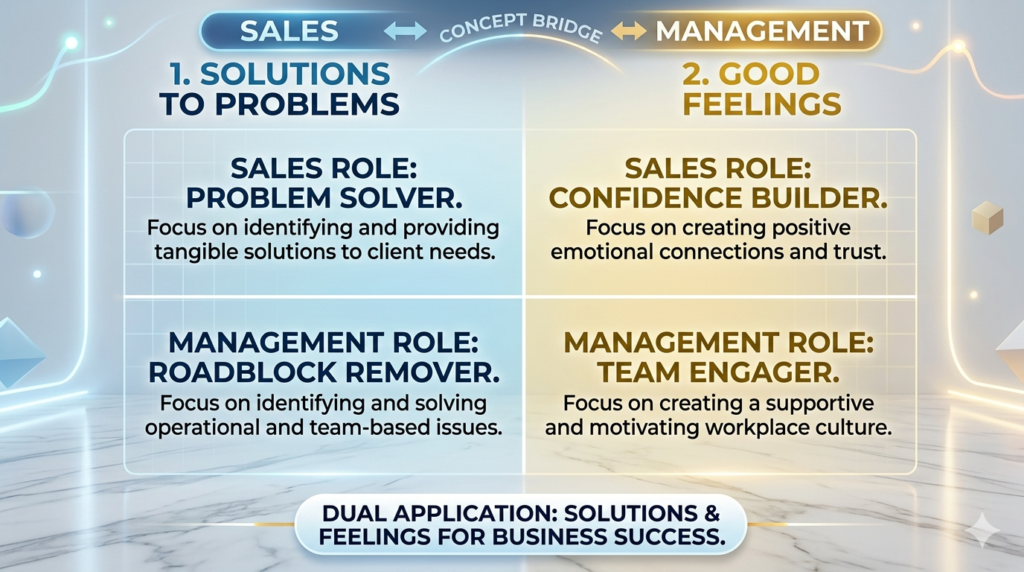
The Shared Foundation of Sales and Leadership Principles
In sales, I always said that good feelings will take care of themselves. Solve my problem and provide good customer service, and I’m going to feel pretty good about the transaction. The same is true in management and leadership.
The good bosses you remember fondly are the ones who solved your problems and provided good customer service. And yes, I believe managers have customers — their employees — and those employees need to be served. The principles of what needs to be done are the same: show appreciation, don’t waste their time, be their partner, and help generate positive results.
Solutions to problems and good feelings. It’s a great approach for sales, and maybe even better for leadership.
Leave a Reply
You must be logged in to post a comment.